
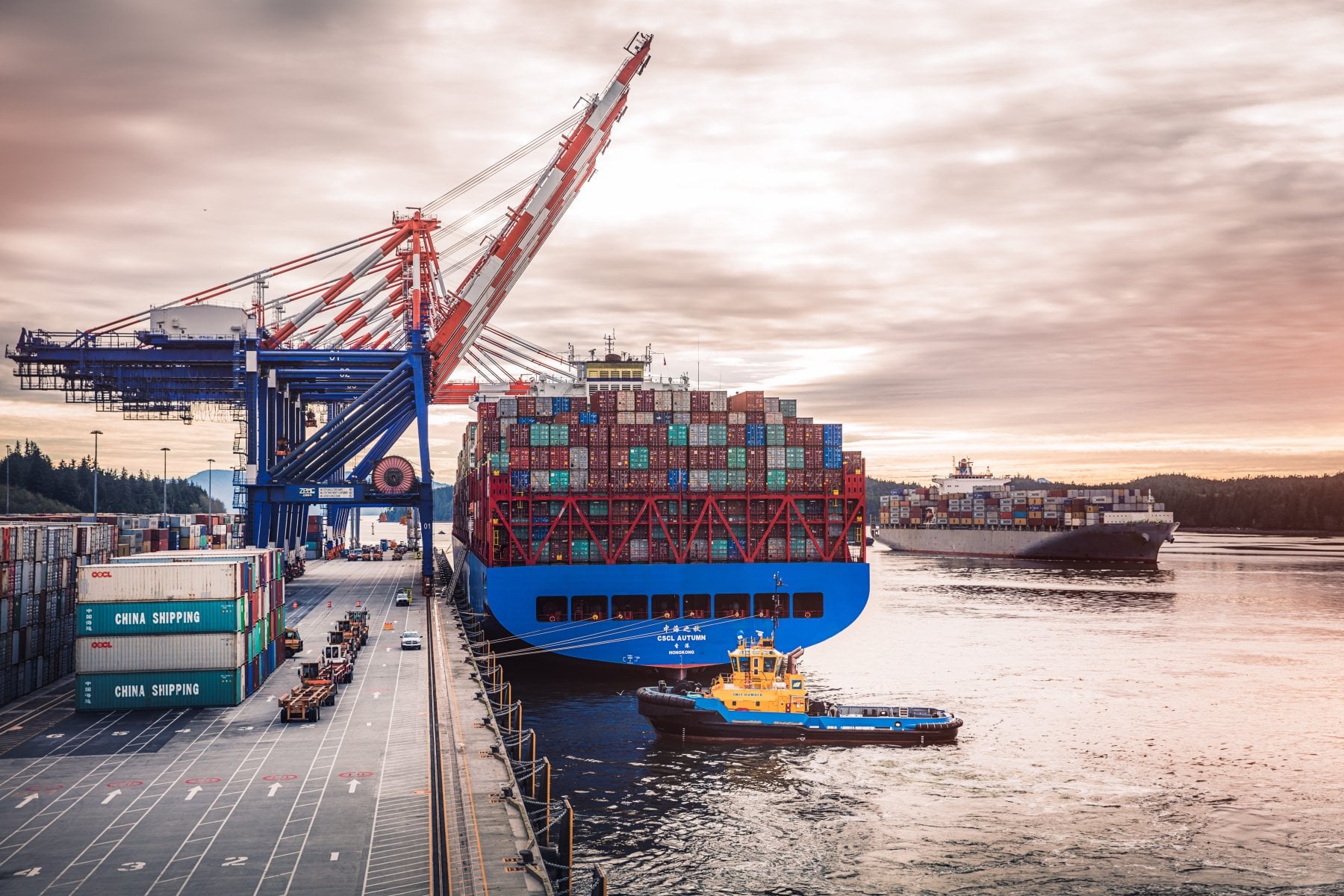
You're not only dealing with isolated disruptions in 2026 but with global structural changes caused by route instability. Shipping lines and carriers have rerouted the majority of Asia–Europe services away from the Red Sea and Suez Canal and around the Cape of Good Hope as a primary alternative, significantly extending voyage distances.
Currently, the market is facing an additional 10–20 days per voyage. What is more important is increasing vessel cycle time. As ships take longer to complete each rotation, the number of available sailings decreases.
Let’s go through the market capacity overview in March 2026.
How rerouting reduced shipping capacity
Traffic through the Strait of Hormuz has effectively collapsed, with vessels avoiding the region entirely due to security risks and lack of insurance coverage.
Also, major shipping carriers, including Maersk, MSC, and CMA CGM, have suspended or rerouted services away from the Suez Canal and the Red Sea, shifting traffic around the Cape of Good Hope.
The immediate impact:
- transit times extended by 10–20+ days on key routes
- schedule reliability has fallen below 50%
- blank sailings have increased
- vessels are being offloaded at alternative ports due to route uncertainty
- congestion because of network instability (not the volume shift)
Export flows from countries like India are already described as “choking” under the pressure of rising costs, rerouting, and disrupted corridors.
Impact on Europe: Shipping delays and supply chain instability
Europe is the most exposed region to disruptions in Asian-origin logistics. The main issue resulted from the loss of predictability that is far beyond just extended transit times.
What is happening in practice:
- ETAs shift multiple times per shipment
- containers arrive out of sequence
- shipments are frequently rolled to later sailings
Operational impact
| Area | Impact |
| Retail | missed seasonal sales windows |
| Manufacturing | disrupted production cycles |
| Warehousing | uneven cargo inflow |
| Inventory | overstock and stockouts |
European market behavior shows a few trends, such as the addition of 2–3 extra weeks of buffer stock for companies to handle product shortages and delivery delays. Then, overbooking strategies are more frequent than before. Also, currently shipping providers implement dual routing, which uses both sea and rail transport methods.
Transit time updates: Asia to Europe
| Shanghai, CN → Lisbon, PT | 38 days |
| Nhava Sheva, IN → Copenhagen, DK | 33 days |
| Ho Chi Minh City, VN → Marsella, FR | 35 days |
| Bangkok, TH → Stockholm, SE | 39 days |
Source: SeaRates Distance & Time Calculator
Ocean freight rates by route
| Shanghai, CN → Genova, IT | From $2,400 | Check tariffs |
| Nhava Sheva, IN → Antwerpen, BE | From $2,800 | Check tariffs |
| Ningbo, CN → Gdynia, PL | From $1,600 | Check tariffs |
| Ho Chi Minh City, VN → Rotterdam, NL | From $1,900 | Check tariffs |
| Yokohama, JP → Burgos, ES | From $2,000 | Check tariffs |
Freight rates vary depending on the carrier's service offer, seasonality, and capacity availability.
Impact on the United States: Rising costs but flexible routing
The United States is facing the same worldwide disturbance yet its operational results differ from other countries.
East Coast routes show rising transit times because of upcoming delays yet the system maintains better stability through its various transportation network systems.
The current situation involves cargo redistribution between West Coast and East Coast ports while routing decisions are made through real-time processing, as well as inland transportation systems that are utilized to correct flow imbalances.
Operational impact
| Area | Impact |
| Logistics | higher inland transport costs |
| Distribution | increased routing complexity |
| Inventory | higher carrying costs |
| Planning | shift to scenario-based execution |
Market behavior:
- use of mid-term freight contracts
- port diversification strategies
- increased interest in nearshoring (Mexico, LATAM)
Transit time updates: Asia to North America
| Shanghai, CN → Houston, US | 30 days |
| Kyoto, JP → Toronto, CA | 35 days |
| Pusan, KR → Ontario, US | 16 days |
| Kuala Lumpur, MY → Mexico City, MX | 36 days |
Source: SeaRates Distance & Time Calculator
Ocean freight rates by route
| Shanghai, CN → Houston, US | From $2,400 | Check tariffs |
| Nagoya, JP → Long Beach, US | From $2,000 | Check tariffs |
| Yokohama, JP → Ensenada, MX | From $2,300 | Check tariffs |
| Pusan, KR → Montreal, CA | From $2,000 | Check tariffs |
| Port Kelang, MY → Vancouver Centerm Terminal, CA | From $2,400 | Check tariffs |
Freight rates vary depending on the carrier's service offer, seasonality, and capacity availability.
Europe vs USA: Different responses to the same logistics crisis
The disruption itself is global — but the constraints inside each system are different.
That is why Europe and the U.S. are not just reacting differently — they are being forced into different operating models.
| Factor | Europe | United States |
| Main constraint | dependency on long-haul imports | routing flexibility |
| Cost structure | front-loaded (ocean freight) | distributed (ocean + inland) |
| Risk point | arrival timing | total logistics cost |
| Adjustment speed | slow (contract-driven) | fast (spot-driven) |
Europe: System built on predictability — now under stress
European supply chains are structurally optimized for efficiency over distance, particularly the high reliance on Asian imports, centralized distribution hubs, and long planning cycles tied to maritime schedules.
This model of logistics processes works perfectly only when transit times are stable. However, even small inconsistencies (±5–7 days) create disproportionate disruption:
- warehouse planning breaks
- inbound flows don’t match outbound commitments
- contract penalties increase
This is why European companies are reacting conservatively:
- increasing inventory not because of demand — but because of uncertainty
- locking in capacity earlier, even at higher cost
- reducing dependence on single suppliers or routes
The shift is structural: Europe is moving from efficiency → redundancy
United States: System built on flexibility — now under cost pressure
The U.S. system is structurally different. It is not optimized around a single corridor, including multiple ocean gateways, large domestic redistribution capacity, and shorter decision cycles.
This allows companies to react faster to disruption.
However, the pressure shifts into the cost layer:
- inland transport becomes the bottleneck (rail, trucking)
- port switching creates additional handling costs
- inventory is repositioned more often
As a result, the system expands in cost and complexity and trade companies and cargo shippers respond by:
- reallocating budgets from procurement → logistics
- prioritizing service reliability over margin
- using data and real-time visibility to manage flows
The shift is different: The U.S. is moving from efficiency → adaptability
What actually are the differences?
The key difference is not geography — it is where the system absorbs shock:
- Europe absorbs it in time (delays, unpredictability)
- The U.S. absorbs it in money (higher logistics cost)
Let’s sum up
Do not focus only on delays when planning logistics or trading strategies.
Two key chokepoints, the Strait of Hormuz and the Red Sea, are already driving three measurable effects across the system:
- capacity is being removed from the market
→ longer Cape routes are absorbing up to ~2.5 million TEU of global capacity
- flows are breaking at the network level
→ cargo is being offloaded at alternative ports and rerouted mid-journey
- costs are no longer predictable
→ freight rates are rising due to fuel, insurance, and congestion
What does this mean in practice? This is already changing how freight companies, cargo owners, and traders operate:
- staging cargo in multiple regions to reduce exposure to chokepoints
- shifting from single-route logistics to multi-corridor strategies
- accepting higher costs to maintain continuity of supply
If your cargo is being rolled, routes are changing mid-transit, or ETAs are no longer reliable, the SeaRates team can help you secure alternative routing and keep deliveries on track. Contact us at [email protected] with any of your logistics needs.