Navi Capesize
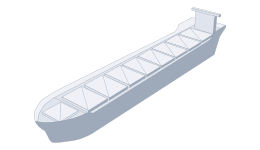
Navi Capesize
Capesize vessels are a type of large shipping vessels. Their basic and most popular area of application is the transportation of bulk cargo. A distinctive feature of these vessels is their very large size. Because of this, they cannot pass through many popular canals: for example, the Panama or Suez. To arrive at the destination, such a giant needs to sail around the Cape of Good Hope or Cape Horn. Actually, because of this, this category of ships received the name “Capesize vessels”. So what we end up with is that the trips are noticeably longer, but the ship can carry a truly impressive amount of cargo.
The average ship of this type has about 150,000 deadweight tonnage. This is really a lot. Due to these features, the vessels are popular among companies that need to transport very large volumes of cargo over long distances.
Distinctive Features of Capesize Vessels
We have already discussed the main feature: very large dimensions. The mentioned 150,000 deadweight tonnage is an indicator of an average ship of this type. But there are models in the world that even exceed 400,000 DWT!
Of course, such models have a colossal draft. Because of this, it can only be serviced in specialized ports. There are not many ports of this type in the world.
Importance for global logistics
The demand for minerals and other bulk goods is constantly growing, and these vessels meet this demand, delivering products on time and in very large volumes. The huge capacity of the Capesize makes the cost of transportation per unit of goods quite low, which, of course, attracts businesses that deal with logistics of this type.
Countries with rich deposits of raw materials rely on these vessels. They export goods efficiently. This, in turn, boosts their economies and global trade networks.
About Challenges
It is not hard to guess the difficulties that such vessels create. Moreover, we have discussed some of them above. Not every port can accept them. Due to their huge size, it is sometimes necessary to choose far from the most optimal routes. Unloading and loading ships takes a lot of time and requires the most modern equipment. However, reducing the cost of transporting one product compensates for all these cons.