

Cross-border e-commerce has become the fastest-growing opportunity that online businesses can not afford to miss. It is expected to grow from 1.6 trillion dollars to 3.3 trillion dollars by 2028.
This means more people are buying products from other countries than ever before. For online sellers, this opens the door to millions of new customers. But selling globally is not as simple as putting your product online. Shipping plays a huge role in your success. Cross-border shipping is not just about sending packages. It affects your costs, delivery time, and customer experience. If you manage it well, you can grow your business faster. If you ignore it, you will struggle to compete in the global market.
This guide will walk you through every aspect of ecommerce shipping for cross-border sellers. Let's dive right in.
Why Cross-Border E-Commerce Is a Must in 2026?
Cross-border ecommerce is growing fast, and sales are taking a bigger share every year. Sellers who only ship locally are missing the ROI opportunities. In 2026, customers don't really care where your store is located; they only care whether you can deliver their products on time. Cross-border sellers competing on Amazon, eBay and Walmart also need to keep pricing sharp across regions, which is where an automated repricing software helps them stay competitive without manually adjusting prices for every marketplace.
Significant growth in cross-border ecommerce is evident, along with strong sea freight from China to the USA, from Europe to Southeast Asia, and from Europe to the Middle East, with rising demand in Africa and Latin America.
Major improvements in infrastructure support this shift. Digital freight platforms, automated customs documentation, real-time tracking, and multi-currency payment systems have made international selling more accessible than ever before. What used to be complicated and slow is now faster, more transparent, and easier to manage.
Choosing the Right Shipping Mode: Air, Ocean, and Hybrid
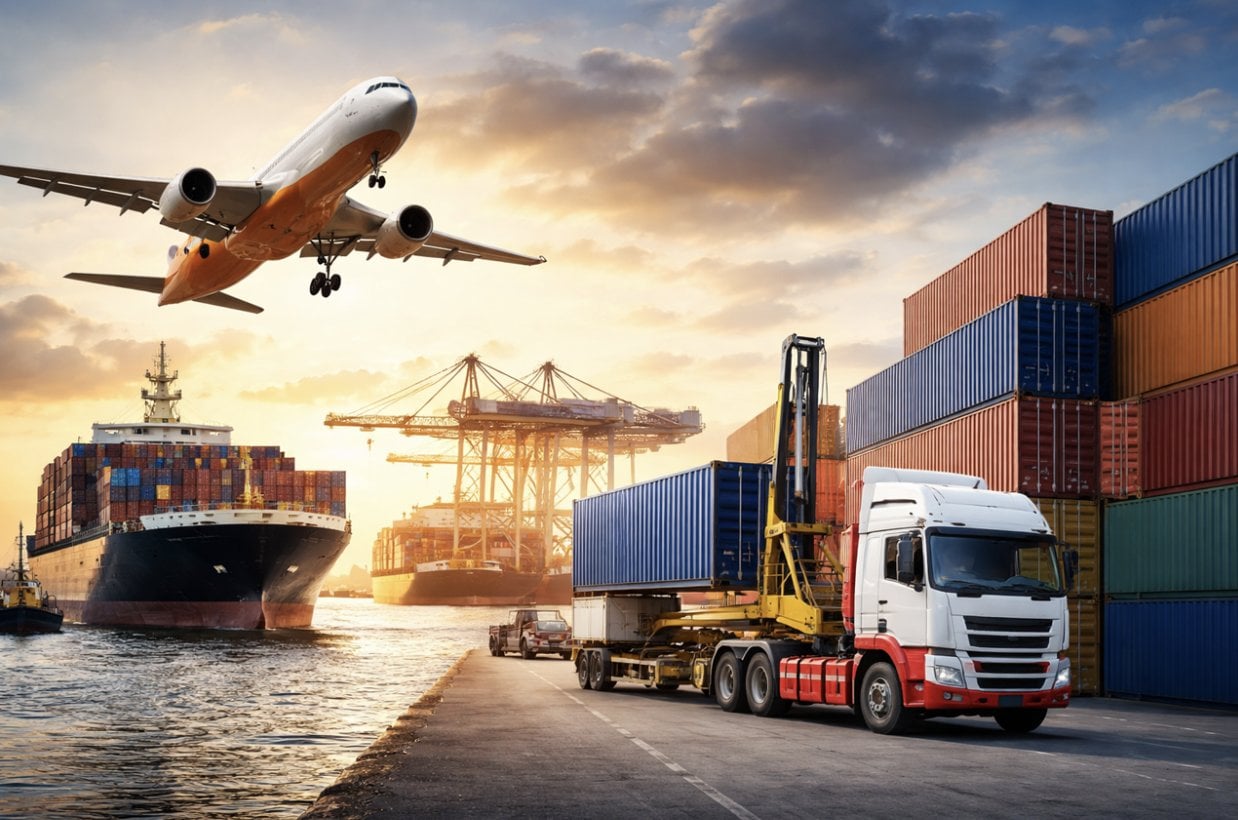
Choosing the right shipping mode is critical because it directly affects your costs, delivery speed, and customer satisfaction in global markets.
Air Freight for E-Commerce
Air freight is built for speed. If you sell lightweight, high-value, or time-sensitive products, this is your default option. Typical delivery takes 3 to 7 days, which makes it ideal for direct-to-consumer brands where fast shipping drives conversions. This model is especially useful for businesses selling custom-printed t-shirts through platforms like Printify and Printful, where products are produced on demand and shipped directly to customers worldwide. Fast delivery helps maintain customer satisfaction and strengthens overall brand reputation. The downside is cost. Air freight is expensive per kilogram, so margins can shrink if you are not careful. This means you need strong pricing and enough profit per order to justify the speed.
Most sellers use express carriers like DHL, FedEx, and UPS. Postal services with international networks are also an option, usually at a lower cost but with slightly slower delivery.
If your customers expect fast delivery or you compete on speed, air freight is not optional. It is necessary.
Ocean Freight for E-Commerce
Ocean freight is about cost efficiency, not speed. It works best when you are moving bulk inventory to warehouses or fulfillment centers in other countries. There are two main options. FCL, or full container load, is for large shipments where you fill an entire container. LCL, or less-than-container-load, is for smaller shipments where you share container space.
Transit times range from 15 to 45 days, depending on the route. That is slow, but the cost per unit is much lower than air freight. This makes it ideal for sellers who plan and pre-position inventory in key markets.
If your business is growing and you want to scale profitably, ocean freight becomes essential. It protects your margins.
Hybrid and Multi-Modal Strategies
Smart sellers do not rely on one method. They combine them. A common strategy is simple. Use ocean freight to send bulk inventory to regional warehouses. Then use air freight to fulfill urgent or direct-to-consumer orders. This balances cost and speed without sacrificing customer experience.
Some sellers also use rail freight between Asia and Europe as a middle option. It is faster than the ocean and cheaper than air travel, making it useful for specific routes.
Packaging Optimization for International E-Commerce Orders
Packaging is not just about protection. In cross-border e-commerce, it directly affects shipping costs, damage rates, and customer experience. Poor packaging increases returns and expenses. Smart packaging decisions improve margins and reduce operational problems at scale.
Why Packaging Matters More for International Shipments
International shipments go through many more steps than domestic ones. Packages are loaded, unloaded, sorted, inspected at customs, and transferred between carriers. Transit times are longer, and conditions vary.
Each step increases the risk of damage. Packaging that works for a short domestic delivery often fails during a long international journey.
Dimensional Weight and Cost Impact
Carriers charge based on whichever is higher, actual weight or dimensional weight. This is calculated by multiplying length × width × height, then dividing by a set divisor.
If your box is too large with space inside, you pay more. Even small reductions in size can cut dimensional weight charges by 15 to 25 percent over time.
Right-Sizing and Custom Packaging
Most sellers start with a few standard box sizes. That approach wastes space and money as order volume grows.
To minimize dimensional weight charges and reduce damage rates during international transit, many cross-border sellers invest in custom boxes for products that are sized to fit their specific SKUs, eliminating wasted space and the need for excessive void fill materials.
This approach reduces shipping costs, improves stacking efficiency in bulk shipments, and lowers material waste. It also provides better protection since products do not move inside the box.
Right-sized packaging also improves the unboxing experience. Customers receive a package that feels intentional, not oversized and inefficient. At the same time, using less material reduces environmental impact and lowers overall shipping weight.
Protective Packaging for International Transit
Internal protection matters just as much. Fragile items may need foam inserts or molded pulp. Air pillows and dividers help prevent movement.
Ocean freight requires protection against humidity and vibration. Air freight requires protection against pressure changes and rough handling. If your packaging fails, everything else in your logistics system fails with it.
Customs Clearance and Documentation for E-Commerce Sellers
International shipping fails at customs when the paperwork is wrong, incomplete, or misunderstood. Most e-commerce sellers struggle here, not because it is impossible, but because they ignore details. Customs is rule-based. If you follow the system, your shipments move. If you don’t, expect delays, extra costs, or even confiscation of your goods.
Essential Documents
Every shipment needs a commercial invoice, which shows the product value and details for duty calculation. A packing list explains what is inside the shipment and how it is packed.
For transport, you need a bill of lading for ocean freight or an air waybill for air shipments. These act as shipment contracts and tracking documents. A certificate of origin confirms where the product was made, which affects duty rates. Some products also need special permits or certifications.
If any of these are missing or incorrect, customs can delay, fine, or even seize your shipment.
HS Codes and Tariff Classification
HS codes are global product classification numbers. They tell customs what your product is and how much duty to charge on it.
If you use the wrong code, you risk overpaying, underpaying, or getting flagged. Underpayment can lead to penalties and shipment holds. Always verify your HS codes using official databases or work with a customs broker.
Duties, Taxes, and De Minimis
Most countries charge import duties and VAT or GST. However, some allow low-value shipments to enter duty-free under a de minimis threshold. For example, the United States allows up to 800 dollars, while the EU threshold is much lower.
You also need to choose between DDP and DDU. DDP means you pay duties upfront, which creates a smoother customer experience. DDU shifts the cost to the customer, which often leads to failed deliveries.
A Quick Checklist for Cross-Border Sellers
Use this quick checklist to turn planning into execution and start shipping internationally with clarity and control today.
- Identify your highest-potential markets using demand data and shipping costs
- Research customs rules, duties, and restricted items for each destination
- Choose shipping mode based on speed, cost, and reliability needs
- Set up accounts with two or three carriers covering key regions
- Negotiate rates once you reach consistent shipment volume
- Optimize packaging to reduce dimensional weight and prevent damage
- Implement DDP shipping so customers pay no surprise fees
- Add real-time tracking to your store for better communication
- Define a clear returns process before your first order ships
- Use digital freight and customs tools to automate workflows
Start with one or two markets, master the logistics, then expand with confidence instead of spreading resources too thin.
Conclusion:
Cross-border e-commerce in 2026 is no longer optional for ambitious sellers. Success depends on mastering shipping strategy, customs compliance, and packaging efficiency. By balancing cost and speed, choosing the right logistics partners, and optimizing every step of the fulfillment process, businesses can deliver a seamless global customer experience.
Those who invest in smart systems and scalable operations will unlock new markets, increase profitability, and build a strong competitive advantage in the rapidly expanding international e-commerce landscape.
Explore more opportunities with SeaRates by [contacting us] according to your interest category