

The SeaRates Tracking System is the all-in-one monitoring solution that connects global data sources for 5 shipping types (sea, air, rail, road, and parcel logistics) into a single operational view. Your logistics teams can track shipping processes more closely than ever before.
Let’s discover how the Tracking System allows you to identify delays of all shipping modes in advance and communicate accurate shipment status to customers proactively.
5 in 1: Unified shipment tracking system
Each tracking type is built around the live data updates and operational logic of its transport mode — not a generic “status checker”. This way, the unified Tracking System tool accurately monitors continuous shipments at every stage of multimodal transportation. No matter how many shipments you currently carry and what type of transport you use.
The following 5 types of shipments are available with this single tool:
| Tracking type | Transport mode | Tracking identifier | What you can monitor | Best for |
| Container Tracking | Sea freight | CT, BL, BK | Vessel movement, route milestones, container location, ETAs | FCL and consolidated ocean shipments |
| Air Cargo Tracking | Air freight | Air Waybill (AWB) | Flight status, flight milestones, transit updates | Urgent and time-sensitive cargo |
| Rail Tracking | Rail freight | Tracking numbers (shipment or equipment) | Wagon movement, terminal milestones, and inland transit status | Long-distance and Eurasian rail routes |
| Road Tracking | Road transport | Tracking numbers (shipment or equipment) | Shipment progress, route milestones, and delivery status | Inland transport and last-mile delivery |
| Parcel Tracking | Parcel networks (linear&multi-modal) | Tracking IDs | Pickup, transit, out-for-delivery, delivery status | E-commerce and small parcel shipments |
Container Tracking (Sea Freight)
What is Container Tracking?
220+ global and regional ocean carriers, shipping lines, and leasing companies supported in one place.
Container Tracking by SeaRates allows monitoring ocean freight shipments using container numbers, bills of lading, or booking references, with live visualization on a global map.
In result, you get:
- live container location and movement
- vessel details, voyage info, and route history
- port milestones (loaded, departed, arrived, discharged)
- all logistics events (e.g., Predictive ETA)
Shipment card for sea transportation. Get the Container Tracking guide here.
Tracking data is aggregated from ocean carriers, port terminals, and AIS vessel data, providing near real-time container status across major trade lanes.
Moreover, you can instantly book the best freight rate available on the market right at the moment for this shipment or request an individual quotation from our team.
Web integration & API connection
- If you’re interested in tracking containers by sea on your website (for you and your customers), we offer a white-labeled integration for your own customized Container Tracking;

- To synchronize cargo tracking across your CRM, TMS, and ERP systems, apply for the Container Tracking API and get your own monitoring tool.
Air Cargo Tracking
What is Air Tracking?
445+ airlines and air cargo carriers worldwide supported.
Air Tracking allows you to monitor air shipments using the Air Waybill (AWB) and provides flight-based cargo visibility across international air routes.
As a result, you get:
- real-time air shipment location
- flight departure and arrival status
- airport handling milestones
- live updates on cargo transit and connection events
- predictive ETA and shipment progress
Shipment card for air transportation. Get the Air Tracking guide here.
Tracking data is collected directly from airlines, cargo handlers, and airport systems, ensuring accurate and timely air freight updates.
Web integration & API connection
- If you’re interested in tracking containers by air on your website (for you and your customers), we offer a white-labeled integration for your own customized Air Tracking;
- To synchronize air cargo monitoring data across your CRM, TMS, and ERP systems, apply for the Air Tracking API and get your own monitoring tool.
Rail Freight Tracking
What is Rail Tracking?
Rail Tracking supports international and regional rail operators and infrastructure providers to ensure shipment visibility across domestic and cross-border rail corridors, especially for long-distance and Eurasian routes. Just enter container, bill of lading, booking number, tracking, or equipment ID.
As a result, you get:
- current wagon or shipment movement in real-time
- terminal and border-crossing logistics events (e.g., Predictive ETA)
- inland transit status and route progress
Shipment card for rail transportation. Get the Rail Tracking guide here.
Rail tracking data is aggregated from rail carriers and rail infrastructure systems, normalized into a unified shipment timeline.
Web integration & API connection
- If you’re interested in tracking by rail on your website (for you and your customers), we offer a white-labeled integration for your own customized Rail Tracking;
- To synchronize rail shipping data across your CRM, TMS, and ERP systems, apply for the Rail Tracking API and get your own monitoring tool.
Road Freight Tracking
What is Road Tracking?
Hundreds of road carriers and fleet data sources are supported.
Road Tracking monitors truck shipments across regional and last-mile transport stages using tracking and equipment IDs.
As a result, you get:
- updates on shipment progress along the route
- delivery milestones and current cargo location
- all logistics events (e.g., Predictive ETA)
Shipment card for road transportation. Get the Road Tracking guide here.
Road tracking combines carrier-provided data and GPS-based fleet information to present a current shipment status.
Web integration & API connection
- If you’re interested in tracking cargo by land on your website (for you and your customers), we offer a white-labeled integration for your own customized Road Tracking;

- To synchronize road monitoring data across your CRM, TMS, and ERP systems, apply for the Road Tracking API and get your own monitoring tool.
Parcel Tracking
What is Parcel Tracking?
2,400+ global courier and parcel delivery companies supported.
Parcel Tracking will enable monitoring of individual parcels and packages shipped via international and local courier networks, with automatic carrier detection.
As a result, you get:
- real-time parcel location on an interactive world map
- full delivery status lifecycle (pickup → transit → delivery)
- detailed logistics events and route history
- transshipment points and courier handovers
Parcel tracking data will be aggregated from global courier APIs and postal networks, covering both major carriers and local last-mile providers.
Web integration & API connection
- If you’re interested in tracking parcels on your website (for you and your customers), we offer a white-labeled integration for your own customized Parcel Tracking;
- To synchronize parcel monitoring data across your CRM, TMS, and ERP systems, apply for the Parcel Tracking API and get your own monitoring tool.
How to use the unified Tracking System?
Step 1: Select the shipment type
You can see the field All carriers by default, and you can select the shipment type based on the required transport mode: sea, air, rail, or road.
Each option opens the particular tracking interface we at SeaRates optimized for that specific shipment type and data source.
Also, you can select shipping lines and carriers for even more precise sea cargo tracking.
Step 2: Enter the tracking identifier
Depending on the shipment type, you can enter:
- container number, bill of lading, or booking number (sea)
- Air Waybill (AWB) number (air)
- rail shipment or wagon reference (rail)
- truck ID, or shipment reference (road)
- parcel tracking number from the courier provider (parcel)
Step 3: Carrier autodetection & data insights
The Tracking System automatically identifies the relevant carrier, shipping line, land transportation provider, or courier and connects to the appropriate data sources:
- shipping lines, terminals, and AIS systems (sea)
- airlines and airport handling systems (air)
- rail operators and infrastructure networks (rail)
- road carriers and GPS fleet data (road)
- courier and postal networks (parcel)
Step 4: Shipment cards and data aggregation
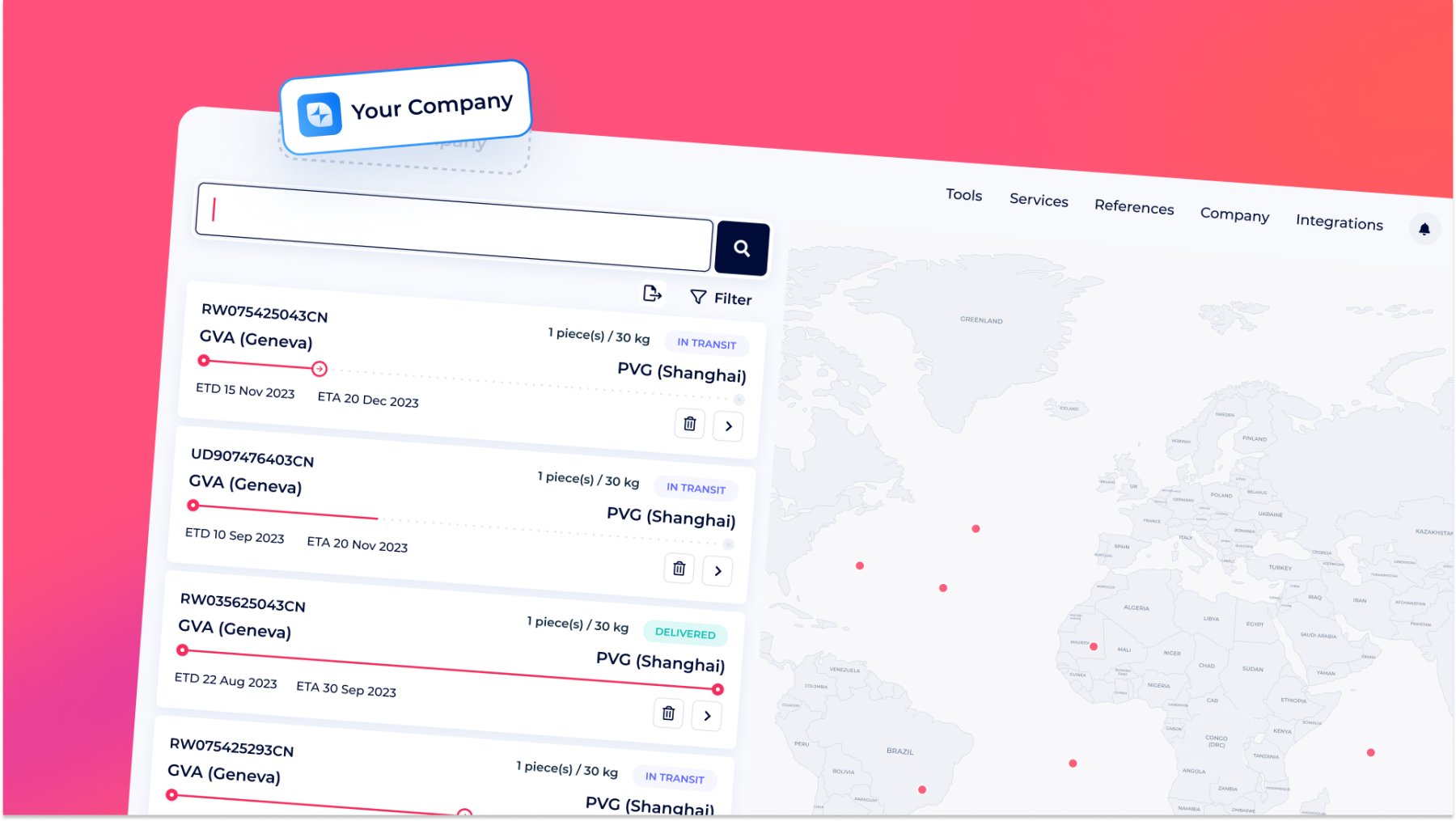
Each of your shipments has a shipment card with real-time updates and key logistics information, ensuring your multitracking proceeds smoothly and comprehensively.
There are consistent statuses, route history, logistics events ( e.g., predictive ETAs), completed and upcoming milestones, carriers’ information, exceptions, transport unit’s details, and more.
Also, check out the visualized routes for each of the shipments on the world map.
Step 5: Ongoing Monitoring and Updates
Monitor new carrier data and shipping progress continuously without checking individual carrier websites. Just run through your shipments list and update the status for the required ones:
Step 6: Operational use and tracking data sharing
Copy a link to the shipment card and share it with your customers and partners. Provide them direct access to real-time shipment details and valuable freight insights.
To sum up
Each party in the supply chain and logistics operations has extremely required shipping visibility for further planning, clarity management, and end-to-end control.
SeaRates believes that instead of tracking fragmented carrier statuses, a single, unified monitoring system is necessary to maintain focus and accuracy in modern logistics. By tracking all modes of transport and carriers in a single system, you can save more resources and simplify trade.
If you need a customized tracking solution, branded visibility of your shipments, or deeper system integration, please contact our IT sales team at [email protected].
Frequently Asked Questions
What is the SeaRates Unified Tracking System?
The SeaRates Unified Tracking System is a tracking system that allows users to track shipments across various modes of transport, including sea, air, rail, road, nad parcels in one place. The tracking system utilizes transport mode-specific tracking data, not general shipment status data.
What types of shipments can I track with SeaRates?
SeaRates allows users to track sea, air, rail, road, and parcle shipments. Each mode of transport has its unique set of tracking data and numbers.
What tracking numbers can I use?
SeaRates allows users to track shipments using container (CT) numbers, bill of lading (BL) numbers, and booking number (BK) numbers for sea cargo, Air Waybill (AWB) numbers for air cargo, and rail and road cargo shipment and equipment numbers, as well as courier tracking numbers for parcel tracking services.
Is the tracking information updated in real time?
The tracking data provided is the latest information available from the carriers and the infrastructure. The frequency of the updates varies depending on the transport mode.
How is SeaRates different from carrier tracking websites?
SeaRates aggregates the tracking information from various carriers and shipping lines, transport modes, and a global route network, making it possible to avoid using different websites.
Who is the SeaRates Tracking System best suited for?
The SeaRates Tracking System has been designed for shippers, traders, freight forwarders, 3PL, and logistics companies that ship goods on a regular basis.