

In freight management, time, accuracy, and flexibility are key, and the manual processes are no longer efficient, as they have become old-fashioned.
It is possible to streamline the entire process of planning, tracking, selecting routes, and many other shipping needs by API (application programming interface) integration. Logistics technologies provide the ability to very closely estimate delivery times, improve the allocation of resources, and guarantee the unimpeded flow of goods within the supply chain.
Here are 7 points of automation that make logistics more open and adaptable, as well as assist you in keeping in sync with global trade.
1. Plan the proper load
The cornerstone of each and every optimized logistics process is an efficient plan on how to load cargo correctly. By means of the Load Calculator tool, logistics managers can connect to the API and automatically establish:
- how many containers or trucks will be used for a specific shipment;
- the container’s cargo arrangement is the most suitable and secure to avoid penalties;
- loading instructions that strike a balance between less damage and more space usage.
Let's check out an example:
Shipment information:
- Cargo type: General cargo
- Total weight: 10,000 kg
- Container type: 40' High Cube (HC)
- Container volume: 67.7 m³
Shipment dimensions:
- Length: 12 m
- Width: 2.4 m
- Height: 2.6 m
Calculation results:
- Total number of containers required: 1
Container utilization:
- Weight utilization: 95% (10,000 kg / 10,500 kg capacity)
- Volume utilization: 85% (67.7 m³ / 80 m³ capacity)
Additional information:
- Max load weight per container: 10,500 kg
- Max volume per container: 80 m³
- Available weight capacity: 500 kg
- Available volume capacity: 12.3 m³
This way, hours spent in calculations are eliminated, and the space is being used to the fullest, which means less resources spent on shipping and a lower risk.
2. Perfect timing and route choice
Once the cargo planning is finished, it is time to determine what the optimal route is. The Ship Schedules tool provides API connection to let you integrate updates about the ships that are operating on a particular route, by vessel, or port and their sailing times.
1. Search by points: define the departure and destination points to receive voyages between any two points. Pick the best routes according to any parameter, including departure and arrival times.
Example of an API query:
| Departure port: | Shanghai (CNSHA) | Arrival port: | Rotterdam (NLRTM) |
Example of the API response:
| Departure date: | November 12, 2025 |
| Arrival date: | November 26, 2025 |
| Carrier: | MSC |
| Vessel: | MSC Dragon |
| Transit time: | 14 days |
2. Search by vessel: provide the IMO or vessel name to discover its upcoming voyages during a requested time frame.
Example of an API query:
| Vessel name: | MSC Dragon | IMO number: | 1234567890 |
Example of Voyage information:
| Departure port: | Shanghai (CNSHA) |
| Arrival port: | Rotterdam (NLRTM) |
| Departure date: | November 12, 2025 |
| Arrival date: | November 26, 2025 |
| Carrier: | MSC |
| Transit time: | 14 days |
3. Search by port: input the ports of departure and arrival to obtain a list of voyages with the carrier, vessel, departure, and arrival dates.
Example of an API query:
| Port: | Shanghai (CNSHA) |
Example of results:
Scheduled departures:
| Departure Date: | November 12, 2025 |
| Arrival Port: | Rotterdam (NLRTM) |
| Carrier: | MSC |
| Vessel: | MSC Dragon |
| Transit Time: | 14 days |
Arrival info:
| Arrival Date: | November 26, 2025 |
| Carrier: | Maersk |
| Vessel: | Maersk Line 123 |
| Transit Time: | 14 days |
The Ship Schedules API streamlines the process of retrieving ship schedules across ports, vessels, and routes and connecting the data with your internal logistics software or CRM/TMS/ERP system. So, you can select the best option for your shipments without extra manual searching.
3. Accurate delivery distance and transit time
Next, logistics requires automation of freight movement planning by sea, air, road, or rail based on real-world data. Is there are any methods you can find the shortest or the most efficient route and calculate transit time prediction without manual efforts?
The Distance & Time is an excellent solution for calculating the distance and estimated transit time between any two points for linear or multimodal routes. Also, directly connected API ensures automated calculation for custom routes right in your system.
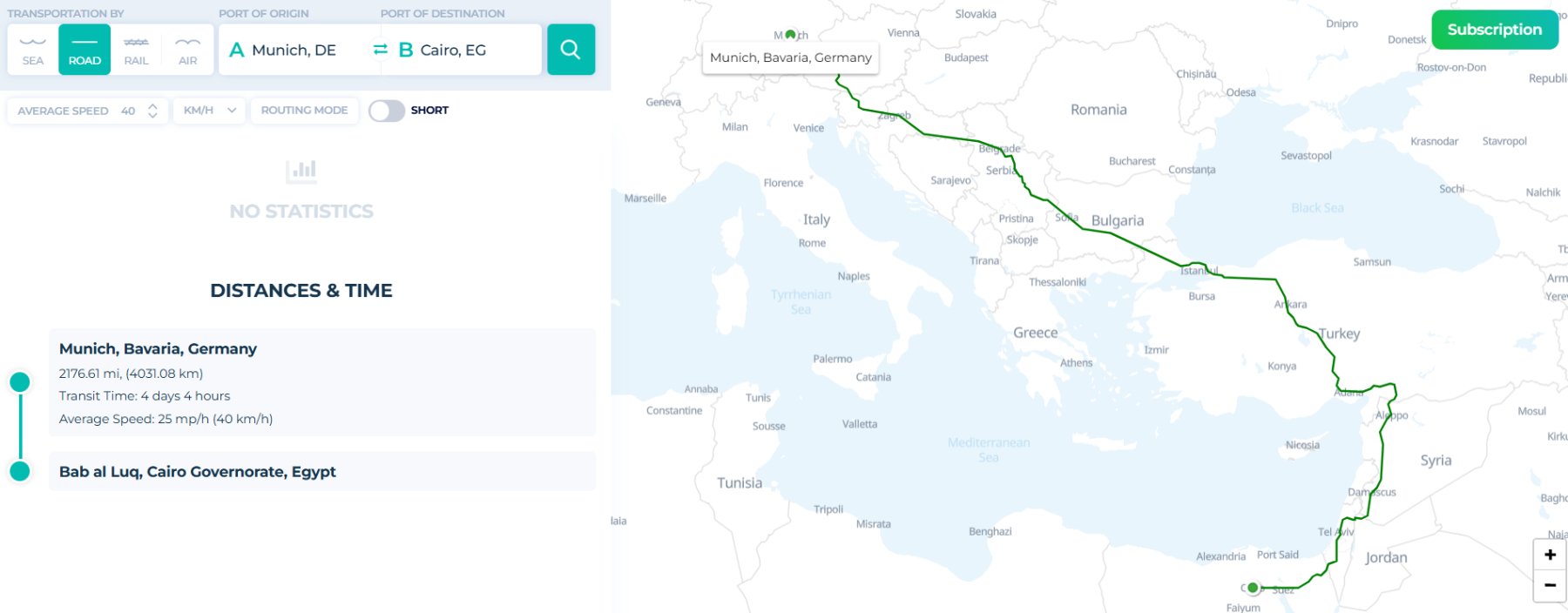
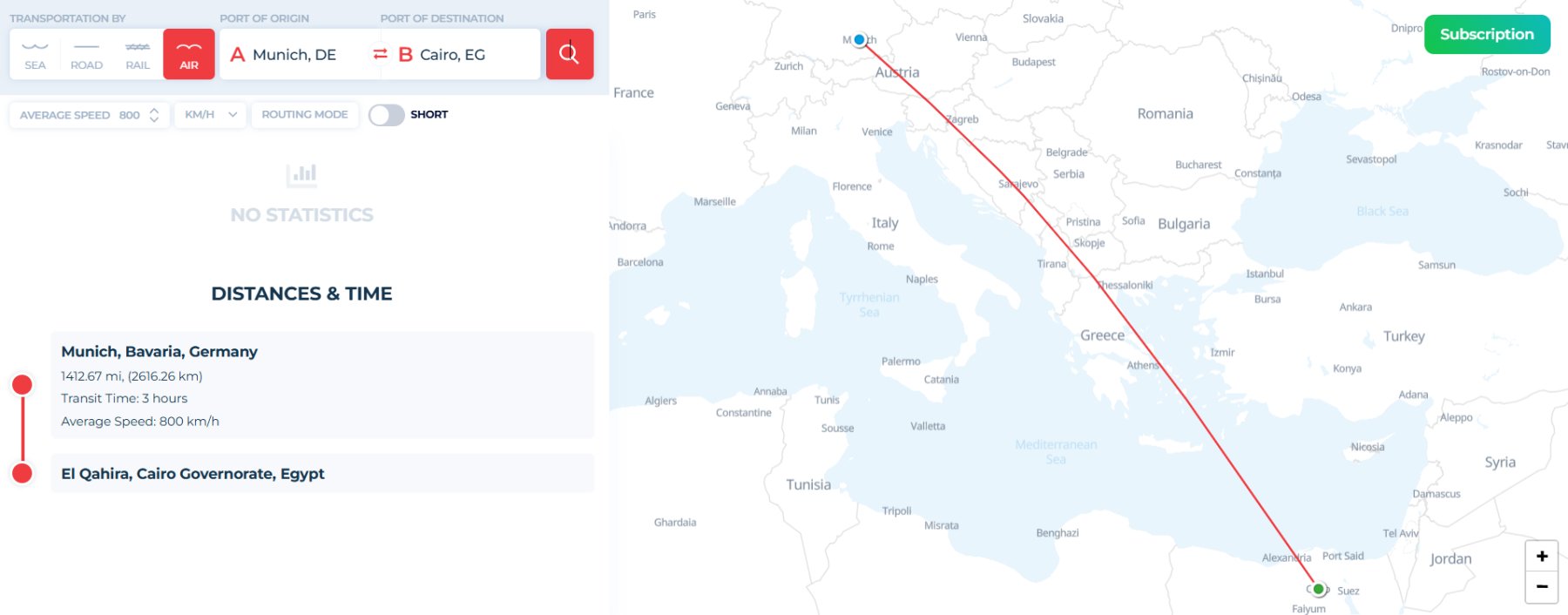
Let's take a scenario of a shipment from Munich to Cairo:
Firstly, enter the points of departure and arrival.
Then, start to compare shipping modes (by sea, road, rail, and air).
By choosing sea mode as an example, we have historical data about transit time for this route by major shipping lines right away. For example, it's 34 days by CMA CGM.
Following the card, there is a detailed breakdown of the distance & time data for each route leg:
- Pickup in Gaertnerplatz, Munich → Hamburg port (20 hours by road);
- Hamburg port → Ain Sukhna port (10 days 21 hours by sea);
- Ain Sukhna, As Suways, Egypt → final warehouse in Bab al Luq, Cairo, Egypt (3 hours by road)
- Total Transit Time: 11 days 20 hours

Also check other shipping modes by distance and transit time:
4. Freight rate calculation, benchmarking, and booking — all in one place
As profitability and smart calculations are the keys to shipping operations, let's discover how to automate freight rate management. There is no need to find carriers' tariffs and data on shipping offers by yourself, as you can access a single hub with already connected offers that you can select by your custom requirements.
By implementing the API of our freight rates calculator Logistics Explorer, you’ll proceed with the following:
- Check current freight rates from different carriers and forwarders worldwide.
- Compare and select the best quote based on custom preference, such as full route details, transit time, and selecting pricing breakdown.
- Fix the best tariff, secure cargo space and generate digital quotations or bookings through API integration — with options to send, share, or confirm rates directly via your platform.
If the main purpose of your logistics is convenient management of bookings, the key is to have full-time visibility and easy access to finance monitoring, managing booking statuses, space guarantees, carrier partnership, pickup processing, and more.
5. Cargo visibility in real-time mode
The moment the booking is made, the process of execution starts. Ensure that you avoid any route changes and unforeseen delays for a successful and timely arrival with real-time updates on these details about your cargo:
- Departure confirmation
- Transshipment updates
- ETA predictions
- Detailed info on voyages
- Customs notifications
- Live operations analytics
The Container Tracking is the key for all-around transparency about supplies. Whether cargo is in transit or delivered, be the first to know real-time updates, location, status, and ETA in advance. Just enter the container, booking number, or bill of lading to take proactive measures in the event of delays and reroute the shipment if necessary.
What's the purpose of the Tracking API? Just imagine 24/7 monitoring of shipping up to the second and extended updates that notify you in real time. So, let's stop to image and get these insights synced with your integral logistics system within a few hours.
6. Go greener: Options to compensate for CO₂ emissions
“Aiming to make your supplies more sustainable and eco-friendly? Calculate the entire carbon footprint for each shipment in your supply chain accurately”.
This sounds pretty difficult when you try to do so manually. Instead of it, automatically connect to real-time insights of CO₂ emissions according to carriers and your route coordinates.
All of this is possible by connecting to the Carbon Emissions Calculator API. You’ll receive the following sample of insights:
- Total CO₂ emissions: 2.45 t | Offset cost: $12.45 (Truck 0.32 t | Ocean 2.13 t)
- Your shipment generated 2.45 tons of CO₂ — $12.45 to offset (Road 0.32 t | Sea 2.13 t)
- Carbon footprint: 2.45 t CO₂ (Truck 0.32 t, Ocean 2.13 t) | Compensation cost: $12.45
7. Automate documentation management for logistics
At the last stage, we have to manage shipping documentation based on the custom needs of the provider or shipper. Automation should operate with transparency and be easy to use and result in instant generation, handling, and document storing in your own secure library. The most common pieces to manage are the following:
- Quotation
- Pro forma invoice
- Commercial invoice
- Packing list
- Bill of lading
- Purchase order
- Verified gross mass declaration
- Certificate of origin
- House bill of lading
The point of document management is to retrieve all shipping data to fill out, brand, e-sign, and send documents to customers or customs brokers in less than a minute. Moreover, automation via API lets you cut up to 45 minutes required per shipment. This way, you avoid manual data entry and get guaranteed accuracy in every step of paperwork.
To sum up
The right plan for implementing automation into your logistics business is the following:
1. load planning
2. route optimization in line with sailing schedules
3. transit time prediction
4. freight rate management & booking digitalization
5. real-time cargo tracking
6. carbon offset management
7. and transparent handling of shipping documentation
These 7 steps of practical transformation lead to lower expenses, well-established freight flows, and a better customer experience.
If you’re interested in a custom offer on digital logistics, drop your query at [email protected]. Let’s discuss your step-by-step strategy for an intelligent logistics pipeline and higher shipping revenue.