20 ft. Tank Containers
20' TANK

INSIDE LENGTH:
INSIDE WIDTH:
INSIDE HEIGHT:
DOOR WIDTH:
DOOR HEIGHT:
CAPACITY:
TARE WEIGHT:
MAX CARGO WEIGHT:
6.058 m
2.438 m
2.438 m
0.000 m
0.000 m
0 m3
4190 Kgs
26290 Kgs
Description
Tank containers must be at least 80%% full, to prevent dangerous surging of the liquids in transit. On the other hand, they must not as a rule be over 95%% full, or there will not be sufficient ullage space for thermal expansion. The extent of thermal expansion may be calculated for each cargo on the basis of the following formula:
- ΔV = Va · γ · ΔT
- Ve = Va (1 γ · ΔT)
- ΔV : change in volume
- Va : volume at initial temperature a
- Ve : final volume at temperature e
- γ : coefficient of cubic (thermal) expansion
- ΔT : temperature difference in degrees kelvin
Tank containers intended for transporting foodstuffs must be labeled "Potable Liquids only".
Some hazardous materials must be transported in tank containers with no in- or outlet openings below the surface of the liquid.
Tank containers are generally designed for an operating pressure of up to 3 bar (above atmospheric). The test pressure used is 4.5 bar (above atmospheric).
If the cargo requires temperature-controlled transport, tank containers can be equipped with insulation or heating. The temperature of the cargo may be precisely controlled using temperature sensors.
Figures
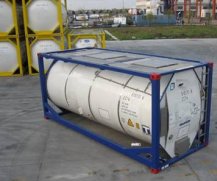
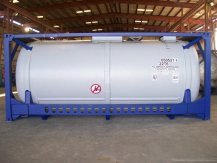
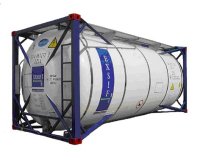
Usage
Tank containers are used for liquid cargoes, such as:
- Foodstuffs: fruit juices, spirits, sweet oils
- Chemicals: hazardous materials, such as fuels, toxic substances, corrosion protection agents